
What Is an HDPE Geocell?
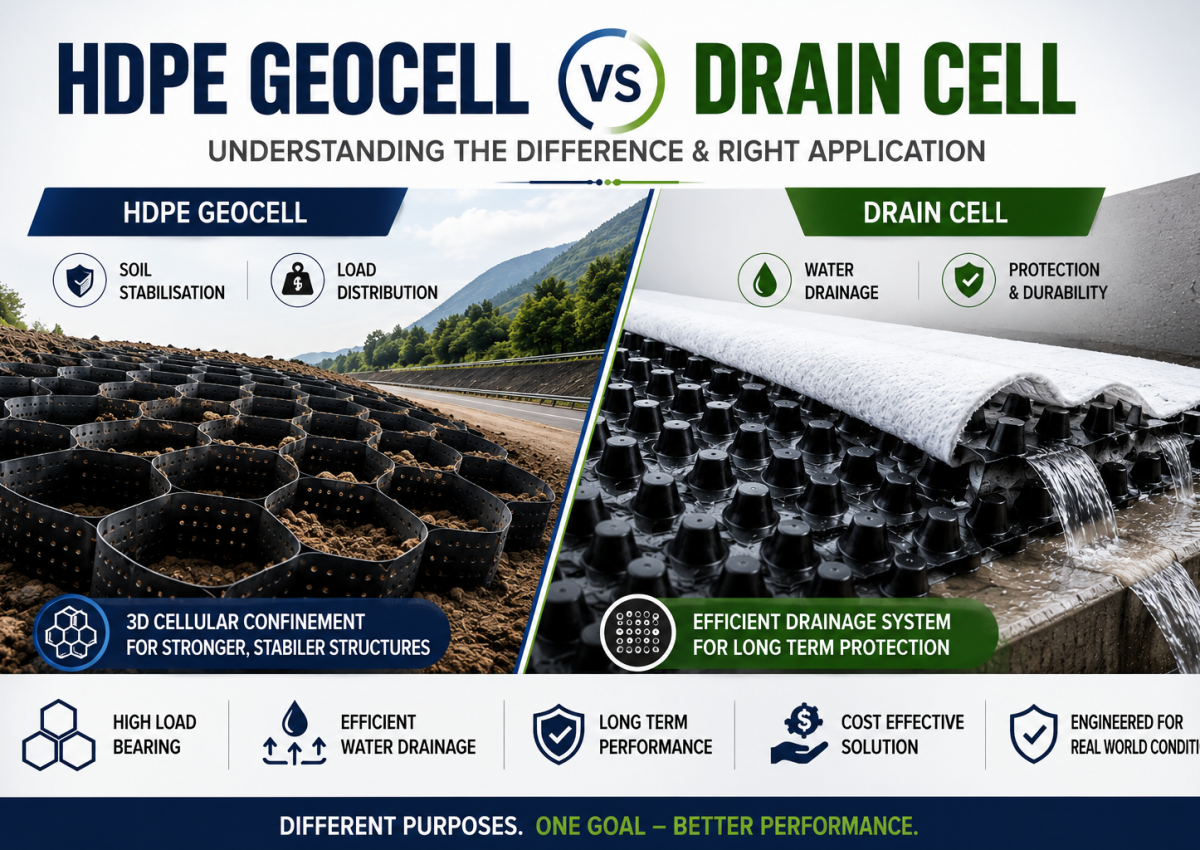
An HDPE geocell is a three-dimensional honeycomb structure manufactured by ultrasonically welding high-density polyethylene (HDPE) strips at intervals to form a cellular matrix. When expanded and filled with soil, gravel, or concrete, the cells confine the infill material and create a composite, load-distributing structureKey Technical Features
- Cell Height: 50 mm to 200 mm (varies by application)
- HDPE Strip Thickness: 1.1 mm to 1.5 mm
- Cell Size: Typically 200mm to 660mm internal diameter equivalent
- Seam Strength: Ultrasonic weld strength ≥ 1800 N (ASTM D4437)
- Colour: Black (carbon black UV-stabilized) for outdoor applications
- Perforation: Available perforated or non-perforated depending on drainage needs
The Soil Confinement Principle
The geocell’s engineering value lies in its ability to confine fill material. When lateral spreading is prevented, even a loose, weak fill material (sand, granular soil) develops significantly higher bearing capacity and shear resistance. HDPE geocell manufacturers like Suntech produce cells that achieve load distribution comparable to a rigid pavement layer at a fraction of the cost.What Is a Drain Cell?
A drain cell (also called a drainage cell or dimple drainage board) is a molded, flat polymer sheet featuring a regular pattern of raised studs, dimples, or egg-crate protrusions. These protrusions create a continuous void space beneath the sheet through which water flows freely under gravity, before being collected and discharged through a drainage system.Key Technical Features
- Thickness: 7 mm to 25 mm (flow void depth)
- Compressive Strength: 150 kN/m² to 400 kN/m² (varies by grade)
- Flow Rate: 3 to 15 litres/min/m at standard hydraulic gradient
- Material: HDPE or polypropylene molded sheet
- Filter Layer: Always paired with a non woven geotextile fabric on the upper face
- Panel Dimensions: Typically 2m x 20m rolls or rigid panels
The Critical Difference: Confinement vs Drainage
| Feature | HDPE Geocell Soil Stabilisation & Load Distribution | Drain Cell Sub-Surface Water Drainage |
|---|---|---|
| Structure | 3D honeycomb — expandable cellular matrix | Flat dimple/egg-crate sheet |
| Primary Function | Soil confinement and load distribution | Sub-surface water drainage |
| Fill Material | Soil, gravel, concrete, or sand | Air and water (void space) |
| Installed Thickness | 50 mm – 200 mm | 7 mm – 25 mm |
| Load Bearing | High — distributes concentrated loads | Moderate — carries overburden only |
| Water Management | Limited (unless perforated) | Primary function — high flow rate |
| Companion Product | Geotextile (optional for slope erosion) | Non woven geotextile (always required) |
| Typical Application | Slope protection, unpaved roads, channels | Green roofs, basements, retaining walls |
| Manufacturer Spec | ASTM D4437, IS 17214 | BS EN ISO 9863, BS EN ISO 11058 |
When to Use HDPE Geocell
HDPE geocell manufacturers recommend geocells when the primary engineering requirement is load distribution, erosion control, or soil stabilization — where a structure needs reinforcement rather than drainage.
Slope Erosion Protection
HDPE geocells filled with topsoil and seeded with grass provide permanent, vegetated slope protection. The cells prevent surface erosion while allowing vegetation to establish roots, creating a bioengineered slope facing. This application is common on highway embankments, rail cutting faces, and riverbank revetments.
Unpaved Road & Load Support on Weak Subgrades
On soft or wet ground, geocell-reinforced working platforms distribute heavy equipment loads, preventing rutting and maintaining site trafficability. This is widely used in construction site access roads, temporary haul roads, and military logistics roads.
Channel & Riverbed Protection
In water channels, geocells filled with concrete or gravel resist hydraulic scour forces that would erode unprotected channel beds. The cellular confinement of concrete provides superior scour resistance compared to conventional riprap or grouted stone at equivalent material cost.
Retaining Wall Facing & Load Distribution
HDPE geocells can serve as facing elements for retaining structures or as load-spreading layers beneath pad footings on soft ground, providing an economical ground improvement solution.
When to Use Drain Cell
Drain cell manufacturers recommend their products when the primary engineering requirement is to manage sub-surface or sub-structure water — creating a controlled drainage path beneath structures, green roofs, or retaining walls.
Basement & Below-Grade Waterproofing Drainage
Drain cells are placed against waterproofed basement walls or beneath basement slabs to intercept groundwater and route it to a perimeter drain or sump pump, preventing hydrostatic pressure build-up that could penetrate waterproofing systems.
Green Roof & Podium Garden Drainage
In intensive and extensive green roof systems, drain cells create the drainage layer that prevents waterlogging of the growing medium. The non woven geotextile filter layer (sourced from geotextile fabric manufacturers like Suntech) prevents fine growing medium particles from clogging the drain cell voids.
Retaining Wall Back Drainage
Drain cells placed against the back face of retaining walls intercept groundwater in the retained fill and route it to weep holes or drainage outlets, reducing hydrostatic pressure on the wall — often the primary cause of retaining wall failure.
Plaza & Car Park Sub-Base Drainage
Below-grade car parks and over-structure plazas use drain cells to manage water from roof drainage and landscape irrigation, routing it to collection systems without saturating the structural slab below.
Can Geocell and Drain Cell Be Used Together?
Yes — and in some sophisticated applications, combining both products provides a comprehensive ground engineering solution:
- Vegetated slope system: Drain cell at the base of slope for drainage + HDPE geocell on slope face for erosion protection and vegetation establishment
- Green infrastructure: Geocell-reinforced access paths over planted areas + drain cell beneath the growing medium for drainage
- Podium construction: Drain cell for waterproofing drainage layer + geocell-reinforced topsoil for heavy vehicle or pedestrian loading on the podium deck
Selecting the Right Manufacturer
When evaluating HDPE geocell manufacturers and drain cell manufacturers, the same quality criteria apply:
- Verify HDPE resin grade — virgin resin delivers consistent weld strength and long-term performance
- Check ultrasonic seam strength test data (ASTM D4437 for geocells)
- Confirm compressive strength and flow rate data for drain cells
- Ensure geocell panel dimensions match project site layout to minimise wasteful cuts
- Request project references from comparable applications
Suntech Geotextile manufactures both HDPE geocells and drain cells with full traceability documentation, NABL-certified test reports, and dedicated technical support for specification and installation guidance.
HDPE geocell is a three-dimensional honeycomb structure designed primarily for soil confinement, load distribution, erosion control, and soil stabilization. Drain cell is a molded sheet with raised studs or dimples that creates a continuous void for sub-surface water drainage. In simple terms, geocell supports and stabilizes soil, while drain cell manages water flow.
HDPE geocell is used for applications where soil confinement, load distribution, erosion control, or stabilization is required. Common applications include slope erosion protection, unpaved roads and weak-subgrade load support, channel and riverbed protection, and retaining wall or ground load distribution.
Drain cells are used to create controlled drainage paths for sub-surface and sub-structure water. Typical applications include basement waterproofing drainage, green roofs and podium gardens, retaining wall back drainage, and plaza or car park sub-base drainage.
Yes. HDPE geocell and drain cell can be combined when a project requires both drainage and soil reinforcement or erosion protection. For example, a vegetated slope can use drain cell for drainage and HDPE geocell on the slope face for erosion protection and vegetation establishment.
Yes. The document specifies that drain cells are paired with a non woven geotextile fabric filter layer. This helps prevent fine soil or growing-medium particles from entering and clogging the drainage voids, particularly in green roof and landscaping applications.
HDPE geocell is the appropriate solution when the primary requirement is slope stabilization and erosion protection. Geocells can be filled with topsoil and seeded with vegetation, helping prevent surface erosion while allowing vegetation to establish. Drain cells may be incorporated where additional sub-surface drainage is required.
Look for manufacturers that can provide verified material quality, seam or compressive strength data, flow-rate specifications, project references, and technical support. For HDPE geocells, ultrasonic seam strength and virgin HDPE resin quality are important; for drain cells, compressive strength and flow-rate data should be checked. Suntech Geotextile. manufactures both products and provides traceability documentation, NABL-certified test reports, and technical support.
Choose the Right Solution with Suntech
HDPE geocell and drain cell are complementary — not competing — products. One confines soil to resist erosion and distribute load; the other creates a controlled path for water to flow freely beneath structures. Understanding the distinction between these products, and knowing which application demands which solution, is the foundation of sound geosynthetic engineering practice.
For projects in India requiring HDPE geocell manufacturers, drain cell manufacturers, or complementary geotextile fabric manufacturers, Suntech Geotextile offers all three product lines from one certified source — simplifying procurement and ensuring material compatibility.