
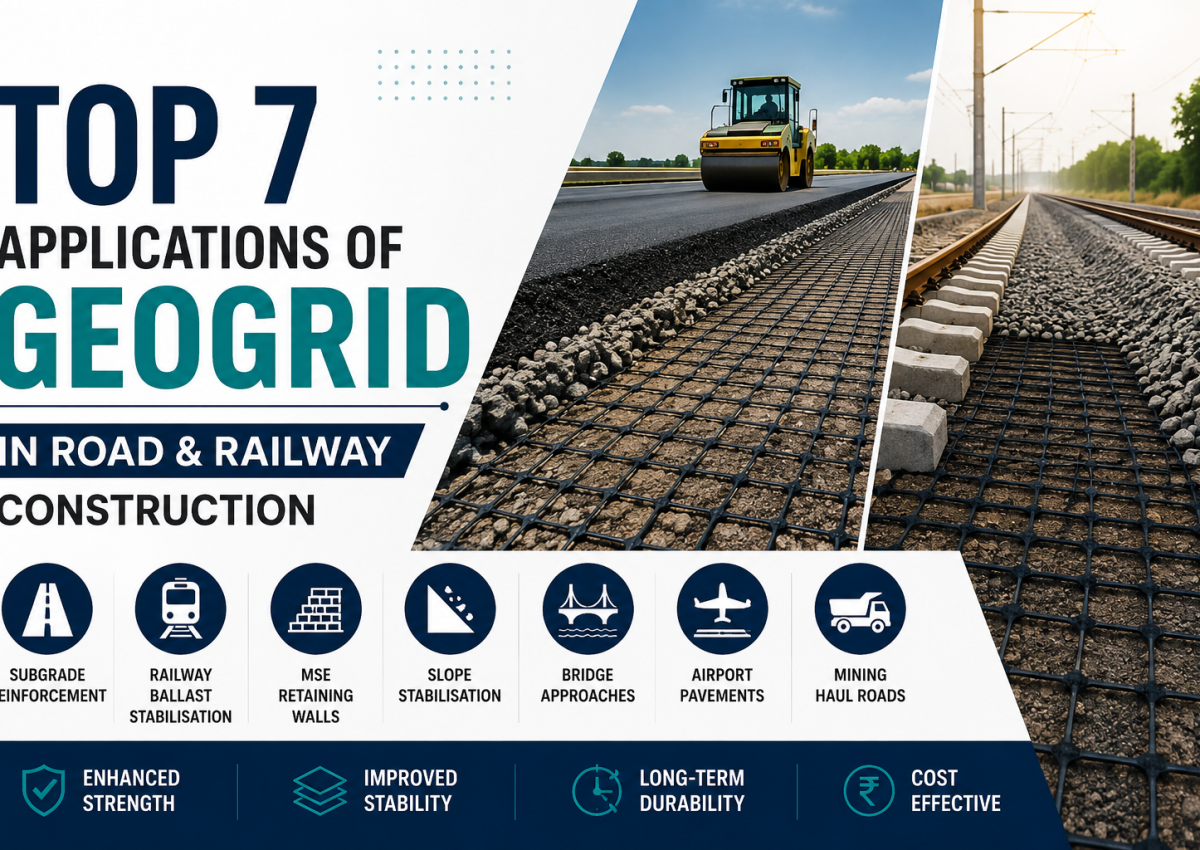
In the race to build faster, stronger, and more cost-efficient infrastructure, geosynthetics have emerged as a transformative technology. Among them, geogrids stand out for their ability to dramatically improve the load-bearing capacity of weak subgrades, extend pavement life, and reduce construction costs.
As one of India’s established geogrid manufacturers, Suntech Geotextile has supplied high-performance geogrids to road, railway, and airport projects across the country. In this comprehensive guide, we walk through seven proven geogrid applications in road and railway construction — with practical insights for every civil engineer and contractor.
What Is a Geogrid?
A geogrid is a planar, open-grid structure manufactured from polymers — typically polypropylene (PP), polyester (PET), or HDPE. Unlike geotextile fabrics, geogrids have large, open apertures that allow soil or aggregate to interlock through the grid openings, creating a composite reinforced mass with significantly higher load-bearing capacity.
There are two main types supplied by geogrid manufacturers:
- Extruded Geogrids: Made by punching and stretching polymer sheets — uniaxial (strong in one direction) or biaxial (strong in both directions)
- Woven/Knitted Geogrids: Made from high-tenacity polyester yarns — high strength-to-weight ratio for demanding applications
Application 1: Subgrade Reinforcement in Flexible Pavements
The most widely used geogrid application globally. When a geogrid is placed at the interface between the subgrade and the aggregate sub-base, the aggregate particles interlock with the geogrid apertures, forming a mechanically stabilized layer that distributes vehicle loads over a wider area.
- Reduces required sub-base thickness by 20–40% — directly reducing material and construction costs
- Increases bearing capacity of weak CBR subgrades from 2–5% to effective CBR of 10–15%
- Extends pavement design life by preventing progressive deformation under repeated traffic loads
Biaxial extruded geogrids from Suntech (geogrid manufacturers) are the standard product for this application, conforming to IS 17183 and ASTM D6637.
Application 2: Railway Ballast Stabilization
Under dynamic train loads, ballast particles progressively migrate and segregate, causing track geometry deterioration that requires frequent and expensive maintenance. Geogrids placed within or beneath the ballast layer prevent this migration by interlocking with the ballast particles.
- Maintains track geometry under heavy axle loads (32.5T and above for dedicated freight corridors)
- Reduces tamping and maintenance cycles — directly reducing lifecycle maintenance costs
- Suntech’s geogrids have been used in Indian Railways projects for mainline and high-speed track upgrades
Triaxial geogrids with 360° stiffness are particularly effective in railway applications due to omnidirectional load distribution.
Application 3: Retaining Wall Reinforcement (MSE Walls)
Mechanically Stabilized Earth (MSE) retaining walls use geogrid layers embedded in compacted fill to resist lateral earth pressure — replacing expensive concrete cantilever or gravity walls with a more economical and flexible alternative.
- Geogrid layers are placed horizontally at 300–600mm vertical intervals in the compacted fill
- Each layer contributes tensile resistance that stabilizes the fill mass
- MSE walls can be constructed to heights of 15–20m+ at 30–60% lower cost than conventional concrete walls
High-tensile uniaxial geogrids with tensile strength of 80–200 kN/m are supplied by geogrid manufacturers like Suntech for tall MSE structures. These conform to ASTM D6637 and relevant IRC standards.
Application 4: Steep Slope Stabilization
Embankments and cuttings steeper than the natural angle of repose are vulnerable to rotational and planar failure. Geogrid reinforcement allows slope angles to be increased beyond their unreinforced limits, reducing land take and construction material requirements.
- Geogrid layers extend into the fill mass, acting as soil anchors that resist failure plane development
- Combining geogrids with non woven geotextile (from geotextile manufacturers) provides both reinforcement and drainage — the leading cause of slope failure
- Vegetated slope faces with geogrid reinforcement provide erosion protection and environmental integration
Application 5: Bridge Approach Roads
The ‘bump at the bridge’ is a well-known problem in highway engineering — differential settlement between the stiff bridge structure and the flexible embankment approach creates a sudden level difference that damages vehicles and passengers. Geogrid reinforcement in the approach embankment compresses this differential.
- Geogrid layers in the approach fill reduce settlement magnitude and rate
- Transition zone reinforcement over the last 10–20m of approach reduces differential deformation
- Reduces maintenance intervention frequency and cost over the road’s service life
Both biaxial and uniaxial geogrids (sourced from experienced geogrid manufacturers) are specified in bridge approach design, depending on the dominant stress direction
Application 6: Airport Taxiway & Apron Stabilization
Airport pavements must support extreme point loads from aircraft undercarriages — often exceeding 50 tones per wheel. On sites with weak natural subgrades, geogrid stabilization provides a cost-effective alternative to deep excavation and replacement with imported fill.
- Reduces pavement layer thickness requirements — saving aggregate and bitumen costs
- Maintains pavement geometry under concentrated aircraft loads
- Speeds up construction — critical for airport expansion projects on tight schedules
Airport geogrid applications are typically designed to ICAO and AAI (Airports Authority of India) specifications. Geogrid manufacturers like Suntech provide product test data required for AAI project approvals.
Application 7: Mining Haul Roads
Mining haul roads carry some of the heaviest moving loads on earth — loaded haul trucks can weigh 300+ tones. On soft or wet ground, these roads quickly rut and fail without adequate ground improvement. Geogrids provide an economical solution that reduces aggregate requirements and maintenance downtime.
- Biaxial geogrids distribute heavy axle loads laterally, reducing stress on the weak subgrade
- Reduces gravel fill layer thickness by 30–50% — significant cost saving on remote mine sites
- Maintains road trafficability during wet season — reducing production downtime
- Suntech geogrids have been supplied for mining haul road construction in central and eastern India
Summary: Geogrid Type vs Application
| Application | Recommended Geogrid Type | Typical Tensile Strength |
|---|---|---|
| Subgrade reinforcement | Biaxial extruded | 15–40 kN/m |
| Railway ballast | Triaxial / biaxial | 30–40 kN/m |
| MSE retaining walls | Uniaxial — high tensile | 80–200 kN/m |
| Slope stabilisation | Uniaxial or biaxial | 40–100 kN/m |
| Bridge approaches | Biaxial / uniaxial | 20–80 kN/m |
| Airport pavements | Biaxial extruded | 30–40 kN/m |
| Mining haul roads | Biaxial extruded | 20–40 kN/m |
How to Choose the Right Geogrid Manufacturer
With multiple geogrid manufacturers operating in India, quality verification is essential:
- Ask for CE, BIS IS 17183, and ISO 9001:2015 certifications
- Verify tensile strength data from ASTM D6637 tests at NABL-accredited labs
- Confirm junction efficiency (how strongly the ribs connect) — critical for load distribution
- Evaluate aperture size — must be compatible with the aggregate particle size used
- Check long-term design strength (LTDS) with creep reduction factors applied
Suntech Geotextile provides full test packages including ASTM, IS, and project-specific test reports for all geogrid supply orders.
Geogrid is primarily used in road construction to reinforce weak subgrades, distribute traffic loads, reduce rutting, and improve pavement performance. When installed between the subgrade and aggregate layer, geogrid creates mechanical interlock with the aggregate, helping distribute loads over a wider area and potentially reducing the required sub-base thickness.
Geogrid improves weak subgrade soil by distributing applied loads across a larger area and restricting lateral movement of aggregate particles. This mechanical stabilization increases the effective bearing capacity of weak soils, reduces deformation under repeated traffic loads, and can reduce the amount of aggregate required for construction.
Yes, geogrid can be used for railway ballast stabilization and track-bed reinforcement. It helps prevent ballast particles from migrating and segregating under repeated dynamic train loads, which can help maintain track geometry and reduce the frequency of tamping and other maintenance activities.
High-tensile uniaxial geogrid is generally used for mechanically stabilized earth (MSE) retaining walls. The geogrid layers are embedded within compacted fill at specified intervals and provide tensile resistance against lateral earth pressure, helping stabilise the reinforced soil mass.
Geogrid is used in slope stabilization by reinforcing the soil mass and resisting the development of potential failure planes. Geogrid layers can extend into the slope fill and help stabilize steep embankments and cut slopes. Combining geogrid with non-woven geotextile can also provide reinforcement and drainage where required.
Yes, geogrid can be used in bridge approach embankments to reduce differential settlement between the bridge structure and the surrounding road. Reinforcement in the transition zone helps reduce deformation and can lower the frequency of maintenance interventions over the road’s service life.
Choose a geogrid manufacturer based on certified material quality, verified tensile-strength data, junction efficiency, suitable aperture size, long-term design strength, and project experience. The blog recommends checking certifications such as BIS IS 17183 and ISO 9001:2015, along with ASTM D6637 test data from accredited laboratories. Suntech Geotextile provides ASTM, IS, and project-specific test reports for its geogrid supplies.
Making the Right Geogrid Choice
Geogrids are no longer a specialty product — they are a mainstream civil engineering solution that reduces costs, extends service life, and enables construction on ground conditions that would otherwise require expensive soil replacement or deep foundation systems.
For road contractors, railway engineers, and project consultants evaluating geogrid manufacturers in India, Suntech offers the certified quality, technical expertise, and project-proven track record that complex infrastructure projects require.