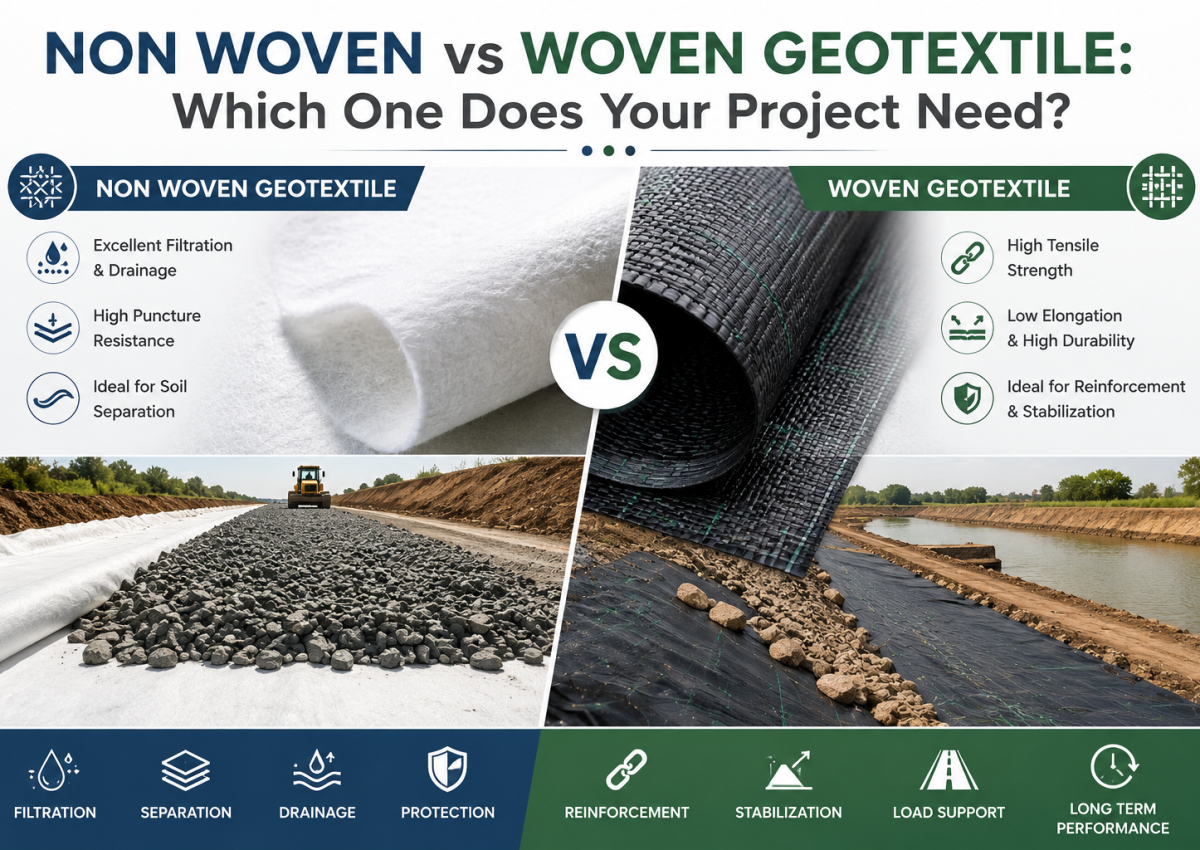
Geotextiles are the invisible backbone of modern civil infrastructure. From highways and embankments to retaining walls and drainage systems, they perform critical engineering functions that directly impact the longevity and safety of structures. Yet one of the most persistent challenges facing engineers and EPC contractors is a deceptively simple question: should I use a non woven or woven geotextile for this application?
The answer depends on the engineering requirements of your project — and getting it wrong can lead to premature structure failure, expensive remediation, and contract disputes. As experienced geotextile fabric manufacturers,
Suntech Geotextile has helped engineers resolve this question across thousands of projects. This guide provides the definitive comparison.
Manufacturing: How They’re Made
Non Woven Geotextile — The Needle-Punching Process
Non woven geotextiles are manufactured by randomly arranging polypropylene or polyester staple fibres into a web, which is then mechanically bonded using thousands of barbed needles (needle-punching) or by applying heat (thermal bonding). The result is a felt-like fabric with isotropic properties — meaning it performs equally in all directions.
Leading non-woven geotextile manufacturers like Suntech produce fabrics ranging from
80 GSM to 1200 GSM, tailored to filtration, separation, drainage, and protection functions.
Non Woven Geotextile — The Needle-Punching Process
Woven geotextiles are produced by interlacing high-tenacity polypropylene tapes or yarns on industrial looms — similar in principle to conventional fabric weaving, but engineered for civil applications. The interlaced structure produces a fabric with high tensile strength in the machine direction, making it ideal for reinforcement applications.
As woven geotextile manufacturers, Suntech produces geotextile fabrics with tensile strength ratings from 20 kN/m to over 200 kN/m, depending on tape thickness and weave density.
Side-by-Side Performance Comparison
| Property |
Non Woven Geotextile |
Woven Geotextile |
| Tensile Strength |
Moderate (10–100 kN/m) |
High (20–200+ kN/m) |
| Elongation at Break |
High (40–80%) |
Low (10–25%) |
| Permeability |
High — Excellent drainage |
Moderate — Limited filtration |
| Filtration (AOS) |
Excellent fine particle retention |
Coarser — Less filtration |
| Puncture Resistance |
High (Thick grades) |
Moderate |
| UV Resistance |
Good (Stabilised grades) |
Good (Stabilised grades) |
| Primary Function |
Filtration, drainage, separation, protection |
Reinforcement, stabilisation |
| Cost (Relative) |
Lower (for equivalent weight) |
Higher (for equivalent strength) |
When to Use Non Woven Geotextile
Non-woven geotextile manufacturers recommend their products when the primary engineering requirement is filtration, drainage, or protection — not load-bearing reinforcement.
- Drainage blankets and filter layers in retaining walls
- Sub-ballast layer in railway track beds (IS 17214 compliant)
- Filter layer between subgrade and aggregate in road sub-base
- Protection layer over HDPE geomembrane in lined ponds and canals
- Erosion control on riverbanks and coastal embankments
- Leachate collection layers in municipal landfills
The key selection parameters for
non woven geotextile include apparent opening size (AOS/O90), permittivity (vertical flow rate), and tensile strength. Top non-woven geotextile manufacturers in India provide certified test data for all these parameters from NABL-accredited labs.
When to Use Woven Geotextile
Woven geotextile manufacturers recommend their products when the primary engineering requirement is high tensile reinforcement under sustained or dynamic loading.
- Subgrade stabilization on weak, soft, or saturated soils
- Reinforced earth embankments and MSE (mechanically stabilized earth) walls
- Basal reinforcement beneath embankments over soft ground
- Slope reinforcement and steep embankment construction
- Temporary haul road stabilization over soft ground
- Separation with high-load applications (heavy traffic areas)
Woven geotextiles have lower permeability than non-woven variants, so when both reinforcement and drainage are needed, they are often combined — with a woven geotextile for reinforcement and a non-woven geotextile for the filtration/drainage layer.
Hybrid Applications: When Both Are Needed
Many advanced infrastructure projects require both geotextile types working in concert. As geotextile manufacturers serving both segments, Sentech regularly advises on these combined applications:
- Railway track beds: Woven geotextile at basal layer for reinforcement + non-woven as sub-ballast filter
- Retaining walls: Woven geotextile as tensile reinforcement + non-woven as drainage filter
- Lined reservoirs: Woven geotextile for slope reinforcement + non-woven for geomembrane protection
How to Select the Right Geotextile Fabric Manufacturers
Whether you need non woven or woven geotextile, the quality of the manufacturer determines project outcome. Evaluate geotextile fabric manufacturers on the following:
- BIS IS 17214 or equivalent international standard certification
- ISO 9001:2015 quality management system
- NABL-accredited third-party test reports for tensile strength, AOS, permeability
- Custom GSM and width options to match project specifications
- Demonstrated supply track record on comparable infrastructure projects
- Technical support for specification writing and material selection
Suntech: Your One-Stop Geotextile Manufacturer
Suntech Geotextile is among the few geotextile manufacturers in India that produces both non-woven and woven geotextiles in-house, under one roof, with consistent quality control across both product lines. This integrated manufacturing capability makes Suntech the preferred supplier for complex projects that require both fabric types.
Build Stronger with Suntech Geotextile
The non woven vs woven geotextile decision is fundamentally an engineering decision — not a cost decision. Non woven geotextile excels in filtration, drainage, and protection roles; woven geotextile excels in reinforcement and stabilization. When in doubt, consult your geotextile manufacturer’s technical team before specifying materials.
Suntech Geotextile , one of India’s most experienced geotextile fabric manufacturers, offers free technical consultation to help engineers specify the right product for every layer of their project.